
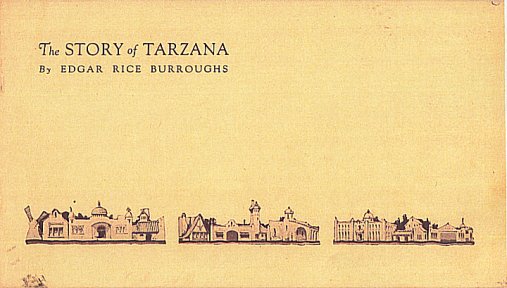
THE STORY OF TARZANA
A rare booklet from the '20s
written and published
by Edgar Rice Burroughs
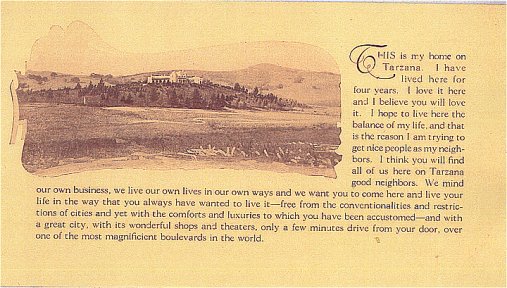 |
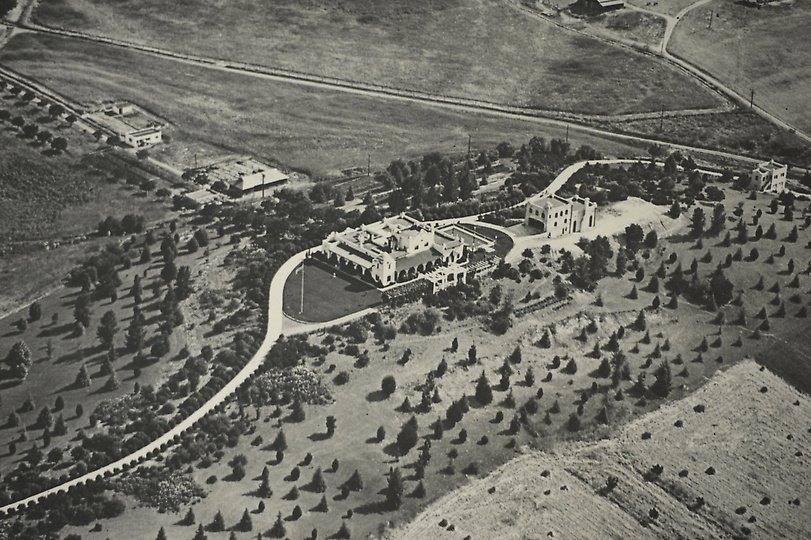
This is my home on Tarzana. I have lived here for four years. I love it here and I believe you will love it. I hope to live here the balance of my life, and that is the reason I am trying to get nice people as my neighbors. I think you will find all of us here on Tarzana good neighbors. We mind our own business, we live our own lives in our own ways and we want you to come here and live your life in the way that you always have wanted to live it -- free from the conventionalities and restrictions of cities and yet with the comforts and luxuries to which you have been accustomed -- and with a great city, with its wonderful shops and theaters, only a few minutes drive from your door, over one of the most magnificent boulevards in the world. |
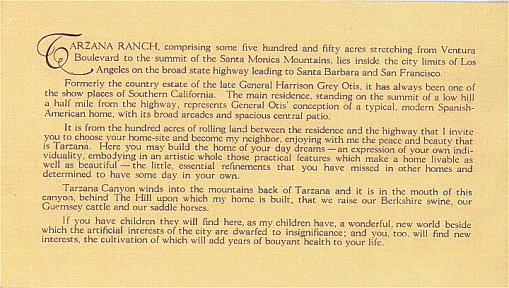 |
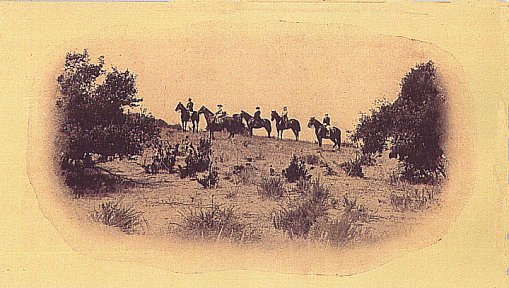
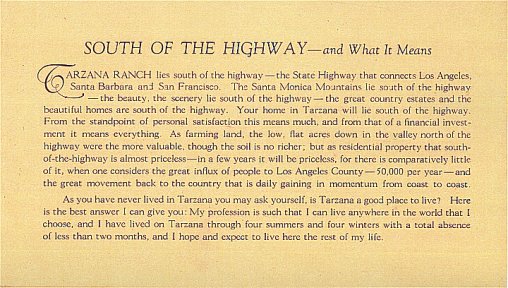
Tarzana Ranch comprising some five hundred and fifty acres stretching from Ventura Boulevard to the summit of the Santa Monica Mountains, lies inside the city limits of Los Angeles on the broad state highway leading to Santa Barbara and San Francisco. |
 |
|
 |
 |
|
 |
|
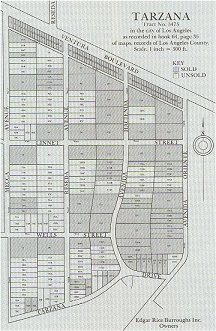

TARZANA RANCH
Edgar Rice Burroughs
From the day he was born in Chicago on September 1, 1875 until he submitted half a novel to All-Story Magazine in 1911, Edgar Rice Burroughs failed in nearly every enterprise he tried.
He attended six different public and private schools before he finally graduated in 1895 from Michigan Military Academy, an institution Burroughs himself described as a ‘polite reform school’.
Having failed the entrance examination to the U.S. Military Academy at West Point, he enlisted as a private in the Seventh U.S. Cavalry, hoping that he might still obtain a commission as an officer if he distinguished himself in a difficult assignment. Thus, he asked to be sent to the worst post in America - a request the authorities speedily granted.
The post was Fort Grant in the Arizona desert, and his mission, as he put it, was to "chase the Apaches". "I chased a good many Apaches", he said, "but fortunately for me I never caught up with any of them".
Private Burroughs soon had his fill of Fort Grant, and after appealing to his father for help, his discharge was arranged through political friends. In 1900, he married Emma Centennia Hulbert, who dutifully followed him back and forth across America during the next eleven years.
He became a cowboy in Idaho, then a shopkeeper, a railroad policeman, a gold miner, and even an ’expert accountant’, although he knew nothing of the profession. Throughout this period, he somehow raised money for a number of his own businesses, all of which sank without a trace.
Life was dismal for the newly married couple. Burroughs became depressed, his wife discouraged. Perhaps to escape from the grim reality of his own life, or perhaps to amuse Emma, he would often sketch darkly humorous cartoons or write fantastic fairy tales of other worlds.
Much later he was to confirm the fact that he wrote all his stories, particularly those of other worlds as much for his own entertainment as for that of his readers.
"In all these years I have not learned one single rule for writing fiction. I still write as I did 30 years ago; stories which I feel would entertain me and give me mental relaxation, knowing that there are millions of people just like me who will like the same things I like. Anyway, I have great fun with my imaginings, and I can appreciate - in a small way - the swell time God had in creating the Universe."
By 1911, Burroughs’ position had become so desperate that not even his cartoons and stories could block out the frustrating fact of his successive failures. He hardly knew where to turn next, and even went so far as to apply for a commission in the Chinese army. (The application was summarily rejected).
Today, that story is acclaimed by scholars as the turning point of 20th Century science fiction, and new editions of it continue to be published each year throughout the world.
But Burroughs was still a long way from becoming an established writer. His next literary effort, an historical novel set in the England of the Plantagenet kings was rejected. He nearly gave up, but his publisher would not hear of it. "Try again," he urged. "Stick with the ‘damphool’ stuff."
He did, and with his next novel his future was decided forever. The novel was TARZAN OF THE APES. An astonishing success on its appearance in All-Story Magazine in 1912, TARZAN OF THE APES brought Edgar Rice Burroughs a mere $700, but after being rejected by practically every major book publisher in the country, it finally was printed in book form by A. C. McClure & Co. and became a 1914 best seller.
A torrent of novels followed; stories about Mars, Venus, Apaches, westerns, social commentaries, detective stories, tales of the moon and of the middle of the earth and more Tarzan books. By the time his pen was stilled, nearly 100 stories bore Edgar Rice Burroughs’ name.
In 1918, Tarzan came to the screen with Tarzan of the Apes, starring Elmo Lincoln, the first film in history to gross over one million dollars. Since then, 41 Tarzan films and 57 one hour television episodes have been produced, each a great financial success.
Although he would joke about it, Burroughs was bitterly disappointed with the Tarzan motion pictures. Often he would not go to see them. His Tarzan was a supremely intelligent, sensitive man. His Tarzan sat in the House of the Lords when not otherwise occupied in the upper terraces of the African jungle. His Tarzan was the truly civilized man - heroic, handsome, and above all free.
In 1919, with financial security assured, Burroughs moved to California where he purchased the 550 acre estate of General Harrison Gray Otis, renaming it ‘Tarzan Ranch’.
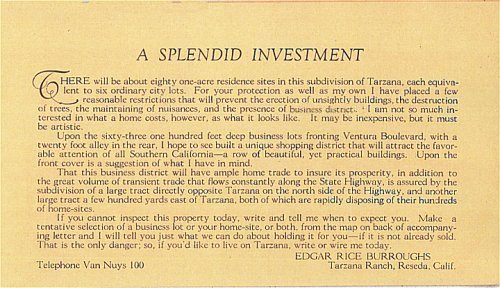
In 1923, the city of Los Angeles had completely surrounded Tarzana Ranch, and Burroughs sold a large portion of it for home sites. In 1930, a post office was established in the community, and the 300 residents held a contest to find a name for the new community. The winning entry was ‘Tarzana’. Today Tarzana has its own park, library, a freeway, banking facilities, bowling centers, medical buildings, country clubs and a bright future for its 35,000 residents in a relatively tranquil atmosphere.
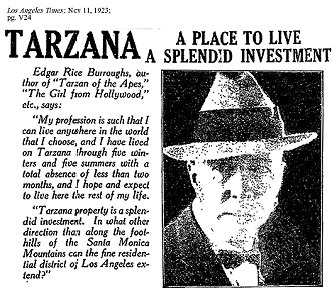
In 1923, Edgar Rice Burroughs became one of the first authors in the world to incorporate himself. By the mid thirties, he was ‘big business’. Daily and Sunday comic strips appeared in over 250 newspapers all over the world; millions of Tarzan comic books were published and sold; and a Tarzan radio serial thrilled its listeners across the country, with Burroughs’ daughter, Jane, and her husband, James H. Pierce, as Tarzan.
Today, Tarzan television programs are syndicated to more than 200 TV stations in the U.S. and abroad, and a Tarzan movie plays somewhere in almost every country in the world every day. With the contemporary emphasis on outer space, Burroughs’ science fiction writings are being printed in even greater numbers.
Most importantly, he is gradually receiving the critical acclaim he was denied in his lifetime. No longer is Tarzan of the Apes considered mere entertainment -- for Tarzan is the ‘Naked Ape’ the tribal ancestor of Marshall McLuhan. And Burroughs’ wild imaginings among the stars are no longer beneath the notice of serious men; they have become subjects for scholars and an inspiration to a new generation of writers of imaginative fiction.
He is remembered as a modest man who never took himself or anything else too seriously. His friends recall his ready sense of humor, his great love of the outdoors and his unbounded pride in his country.
In 1942, he became the oldest war correspondent, covering stories with the Pacific Fleet for United Press. He returned home from the South Pacific only after suffering a series of heart attacks. Ironically, he was unable to find a suitable home in Tarzana, and he spent his remaining years in a modest house in nearby Encino.
It was there, on March 19, 1950, that Edgar Rice Burroughs set down his pen for the last time.
One scholar suggests that the very last line of the very last novel may be taken as Burroughs’ own unintentional valedictory to a very meaningful life:
Sign in with your email address
